Although there seems to be a consensus regarding the optimal working postures, there are some difficulties putting it into practice. Why is that? Where is the problem? Let’s analyse it.
The main goal of ergonomics (the scientific study of people at work) is to prevent soft tissue injuries and MSDs, caused by sudden or prolonged exposure to vibration, repetitive movement and an uncomfortable posture.
Research and progress in ergonomics during recent years has been especially focused on the design of the environment and the teams who perform clinical procedures (“external ergonomics”) but not enough attention has been paid to operator efficiency when it comes to posture and movement (“internal ergonomics”).
According to ergonomics, “posture” is the way in which the different body parts relate to each other establishing a coordination. This coordination can vary depending on the situation. This is the key to internal ergonomics: the right organisation of the various parts of the body, starting with the primary posture coordination between head, neck and back as a support for shoulders, arms and hands.
The right working posture should maintain optimal working conditions (i.e. access, visibility and control of the patient’s mouth) and physical and psychological comfort during the clinical procedure.
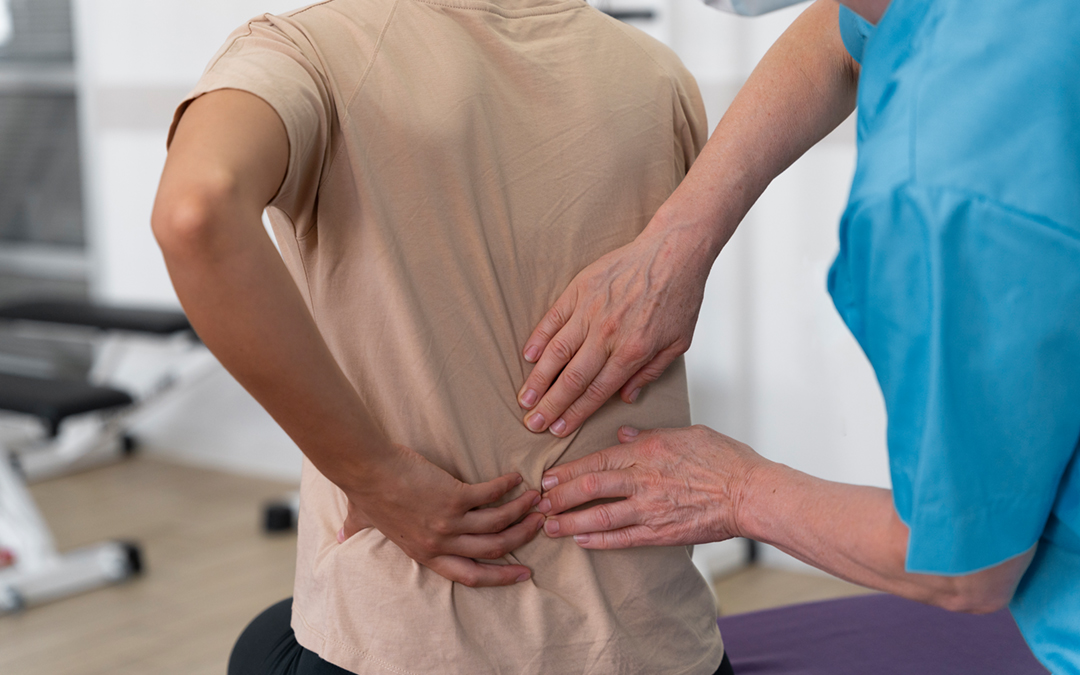
Most dental schools do not teach students how to perform a procedure on their patients without compromising their neck, back and shoulders. Because of that most professionals bend and turn in a harmful way for long periods of time at their workplace. Those common harmful postures are prolonged forced postures (PFPs) that can lead to MSDs.
The most uncomfortable postures usually identified amongst dental professionals are extreme bending forward of the head and neck, trunk inclination and one side rotation, lifting one or both shoulders and increasing the spine thoracic curve.
Movements can be divided into five categories that go from the simplest to the most complex:
Class I: Fingers only
Class I: Fingers and wrist
Class III: Fingers, wrist and elbow
Class IV: Complete arm movement from the shoulder
Class V: Arm movement and body torsion
Most recommended movements are I, II and III, with IV and V being the ones causing more fatigue and require bigger muscular activity.
Experts in dental ergonomics recommend the 9 o’clock working posture (perpendicular) as it allows working with an unrestricted view of difficult to access areas such as the premolars and the molars.
Left leg sits on the posterior side of the chair completely extended horizontally (decubitus supine) so you get an excellent view of the oral cavity. This posture complies with the ISO/FDI graphic charts, which are divided thinking of a clock sphere, where the centre corresponds to the axis of the clock hands matching the patient’s mouth when laying horizontally. Although this has been a significant improvement it is not enough as in addition to a good working position a proper posture is required.
The recommended working posture for dentists is the one called neutral or balanced. It is described in the standard ISO 11226:2000 Ergonomics – Evaluations of static operational postures. It is a natural seated posture, not forced and tension free, considering postural biomechanical principles. It must be comfortable, stable and symmetric. It is not easy to perform because of the interference of acquired and continually repeated bad posture habits. As Dr. Skovsgaard says in “Dancing Hands”: “We do what we are used to do, following our habits without thinking about it or being aware. We don’t know what we are doing, so we don’t think that anything could be different. Habits can turn us blind towards the fact that our manual work can be done in a different way and can achieve different results.”
The main goal of the OPTIMAL DENTAL POSTURE training is to offer efficient and most needed advice. It is based on a theoretical approach, but it is a mainly practical and completely innovative method to achieve an improved posture as a result of learning how to organise and coordinate the different body parts (head, neck, shoulders, back, hips, legs, arms, elbows, forearms, wrists and hands) as a factor in preventing MSDs associated with the dental profession.
The objectives are:
• Offer a consistent theoretical and applicable framework to the workplace: posture biomechanics
• Offer a practical implementation of the biomechanical principles: “internal ergonomics”
• Improve working postures and movements
• Improve significantly and with lasting effect the pain or discomfort caused by prolonged forced postures (PFP) in the cervical area, shoulders, lower back, arms/elbows and hands/wrists
• Improve performance, efficiency, quality and professional enjoyment
• Improve quality of life: feeling less tired and more energetic
• Significant reduction in time off work